

LILA DREAMED IN salt.
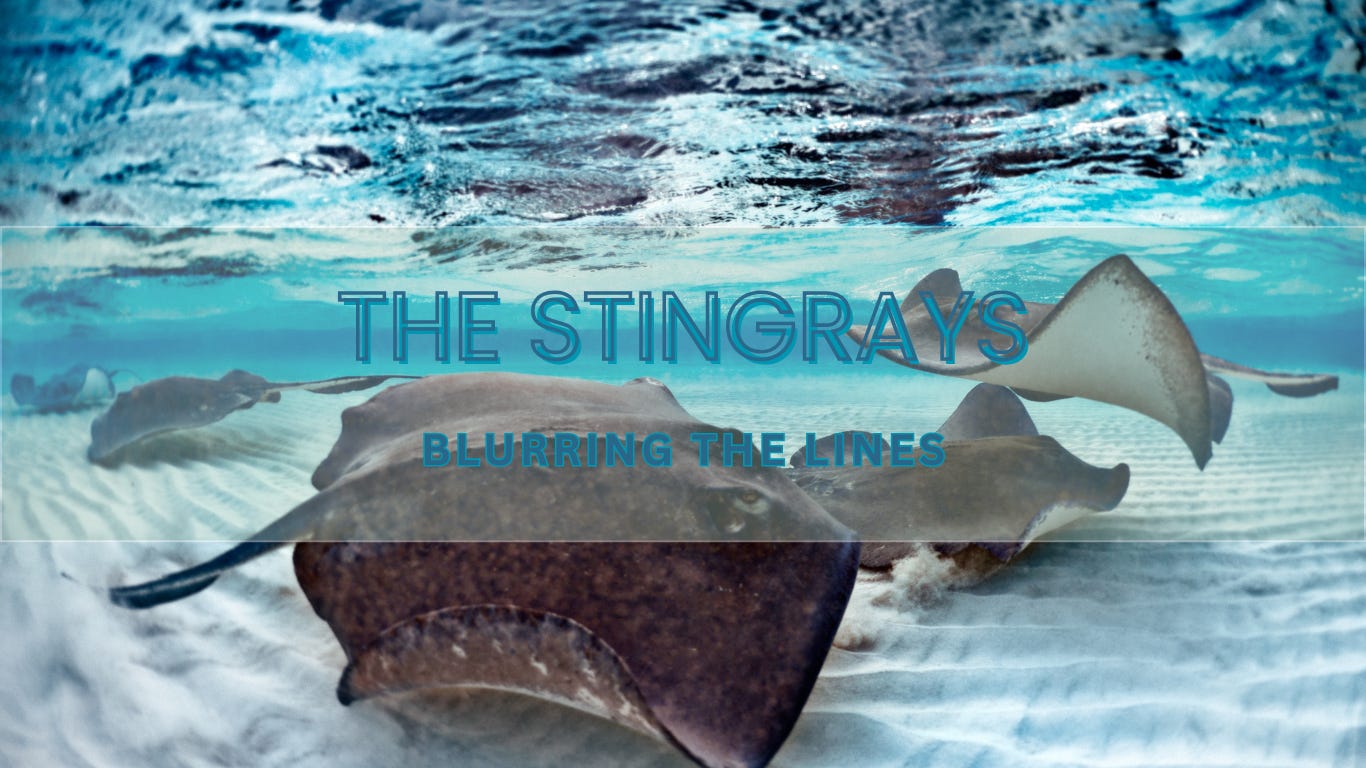
Grand Cayman held her the way a held breath holds a body, and Mia cut through the water beside her, laughing at nothing, the way she’d laughed since they were girls splitting a single bag of chips on the back step in Toronto. Below them, stingrays crossed the sandbar in slow processions, wingtips stirring up little ghosts of silt, the kind of sandbar tourists flew in from three continents just to stand on.
“Look at them,” Mia said. “They’re not even scared of us.”
One peeled off from the rest and came straight for Lila’s outstretched hand. Its skin met her palm like wet suede, cool and alive, and something in her chest loosened that she hadn’t known was clenched. The ray’s eye, black and lidless, held hers a beat too long for an animal that was supposed to know nothing.
Then a man’s voice cracked the morning open. He stumbled in from the shallows half-dressed, a bottle swinging from two fingers, hollering at a joke only he could hear. The rays scattered like a held thought. Lila spun to look for Mia and a barb caught her instead, a thread of pain stitching straight up through her ribs.
She woke up gasping in her own bed.
Dawn was doing its slow gold thing over the water outside the window, and Lila’s heart was going like she’d run somewhere. Her chest still ached, low and specific, right where the barb had gone in. She pressed two fingers to the spot. Nothing there. Skin, ribs, the ordinary architecture of herself.
“You good?” Mia’s voice came muffled through the wall.
“Bad dream.” Lila’s own voice sounded like it was arriving from another room.
She got up anyway, because the smell of coffee was doing what alarm clocks couldn’t, and stopped halfway across the floor when her forearm brushed the doorframe. The skin there had gone strange. Not numb, not quite tingling; something closer to waiting, the way a foot feels right before it falls fully asleep.
In the bathroom mirror her face looked like her face. She told herself that twice.

Lila had spent three years at Vic learning to distrust exactly this kind of thought. Bio-research trained a person out of omens. A body did what cells told it to do, and cells answered to chemistry, not to dreams about rays with old eyes. She’d built her whole adult self on that premise—evidence first, feeling later, if at all—and she clung to it now the way she’d clung to handrails as a kid, knuckles white, refusing to admit the boat was rocking.
Mia, two years into her new life as assistant manager at a bank that overlooked a different shade of blue than anything Toronto had ever offered her, had planned this whole visit around showing her sister why she’d stayed. Snorkeling. Rum cake from the woman down the road. A hammock that didn’t care what either of them had majored in.
“Beach again?” Mia asked over breakfast, already in her suit. “Or are we finally doing the thing where you read a book on the porch like a normal vacationing person?”
“Beach,” Lila said, and surprised herself with how much she meant it.
The pull had nothing to do with sunscreen or scenery. It sat under her ribs like a tide table she hadn’t consulted but somehow already knew. By the time they reached the sand, her legs had gone unreliable beneath her, not weak exactly, just wrong, the joints answering to some other set of instructions.
“You’re walking like you borrowed somebody else’s knees,” Mia said, laughing, and waded in first.
Lila followed her into water the color of a held match flame, clear enough to see her own shadow stretched along the sand. Three steps in, her knees buckled. She went down soft, the water taking her weight the way it had in the dream, and she had one full second of clarity to think: this is not going to stop.
“Mia…” she said, and the rest of the sentence left her in a shape that wasn’t words.
Her spine found a new curve. Her legs forgot they had ever been two separate things and became one continuous, undulant muscle. The world above the surface smeared into a wash of gold and white, and the world below sharpened with a violence she hadn’t expected—every grain of sand suddenly distinct, every fish a separate fact.
She did not drown. That was the strange mercy of it. Her new body already knew how to read the water the way her old one had read a page.
Above her, oblivious for one more breath, Mia turned to point out a school of yellowtail and found the sea where her sister should have been.
“Lila?”
No answer came because no throat existed anymore to make one.

What followed for Mia belonged entirely to the world of people: phone calls that started calm and ended ragged, a constable who wrote things down in a notebook with a curling spine, flyers gone soft and curled at the corners after one night of rain. She walked the beach at both ends of the day, calling a name the water never gave back. Strangers grew tired of her grief before she did. That was its own particular cruelty, the way a missing sister becomes, after the second week, an inconvenience to other people’s vacations.
She stopped going into the bank. Her manager covered for her the first week, then the second, and by the third he stopped covering and started asking when she’d be back at her desk. Mia took the unpaid leave anyway, because clocking back in would have meant agreeing that this was over.
Below the surface, in a world Mia couldn’t follow her into, Lila learned her own body over again. She learned that hunger arrived as a current, that fear flattened her whole shape against the sand, that joy (and there was joy, sharp and undeniable, a fact she resented and welcomed in the same breath) moved through her like a second pulse. Coral stood up around her in shapes too intricate for any lab she’d ever worked in, color blooming in places that made no evolutionary sense she could explain, and for the first time since freshman year, she stopped trying to explain it.
She found the others. Not friends, exactly, not in the way she’d understood the word, but a company of bodies that moved the way she moved now, that knew the same tides by feel rather than tide table. They did not speak. They didn’t need to. A rib-deep awareness passed between them instead, something nearer to weather than to conversation.
Once, weeks in, she let herself drift close to the shallows at dusk, near enough to see the shape of Mia’s calves at the water’s edge, the woman still pacing that stretch of sand like she could wear a path back to her sister through sheer repetition.
Lila came right up against her ankle. Let her wing brush there, soft and deliberate, the way the dream-ray had once brushed her own palm.
Mia went still.
“Lila?” she said, to the water, to no one, to everyone.
The ray held the contact for three full seconds. Long enough to mean something. Then the tide pulled her back out, and Mia stood alone in water gone suddenly ordinary again, her hand pressed flat to her own chest like she could keep whatever had just touched her from leaving completely.
She never told anyone what she felt in that moment. There was no version of it that didn’t sound like grief talking to itself. She came back to that same stretch of beach every evening after, for years, waded in up to her knees at dusk, and waited.
Some nights, something came close enough to touch.
She always touched it back.

Author's Note
This is a story I began writing several decades ago during a period of personal upheaval. It’s not surprising that I dreamed of transforming into a creature without the burdens that threatened to overwhelm me. My therapist (at the time) and I had great sessions with that analysis!
Anyway, no cockroaches or any other kafkaesque transformations here!
I do have one very short creative nonfiction piece involving a cockroach that stars my father and an arch nemesis.

One more thing, swimming with stingrays is an exciting and safe adventure at Stingray City in the North Sound of Grand Cayman. This beautiful sandbar is where southern stingrays hang out and are used to friendly encounters with people. Guided tours allow you to swim, feed, and interact with these fantastic creatures in their natural habitat.
Upcoming…
A prose poem read aloud:
Last Run, 16 August 2025

Thanks very much for reading, subscribing, and sharing the stories, poetry, and essays in this space. If you like a story, poem, or essay, please click on the heart. Also if you are so moved, please leave a comment.

Your writing got me from the first few lines. Your descriptions are beautiful and lyrical. Honestly great writing and an engaging read. Keep writing, fellow writer!
I love this Caro - so well written. I would want to be a bird 🐦 that freedom 🌸