

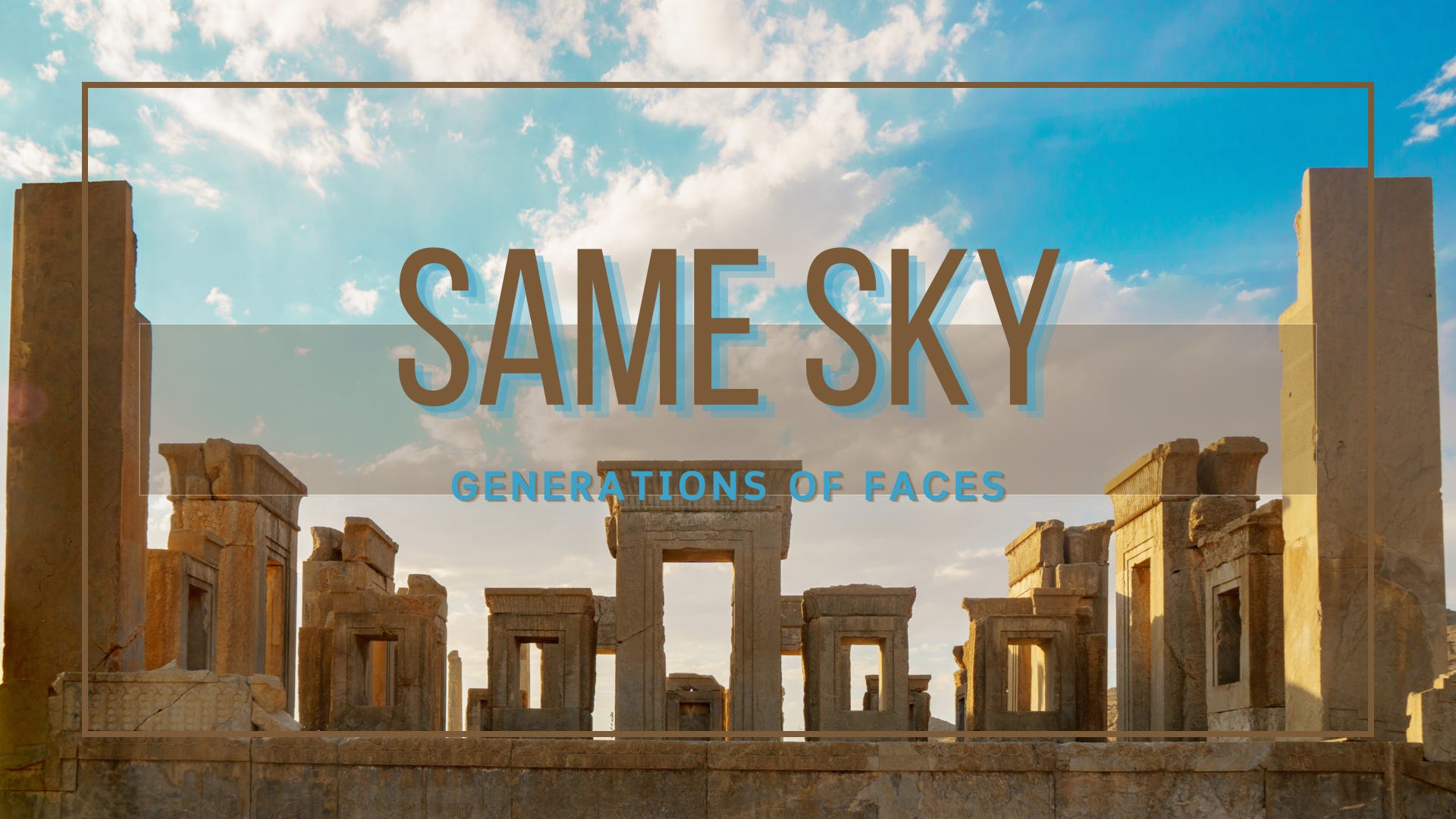
Your grandmother’s cheekbones lived in her mother’s and her mother’s before that; all the way back to someone with no name you’ll ever know, only a posture, a way of holding the jaw against wind. The sky over Persepolis is the same sky. Words arrived in your mouth already worn smooth by someone else’s tongue. You inherited them the way you inherit a coat too large, the shape of another body still pressed into the shoulders. Somewhere a column stands cracked at a clean angle, the burning almost careful. Three thousand years and the stone still holds the outline of a hand that worked it. The hand means something different now. Threat. Calculation. Target. Pride drank first. Then greed. The ground hardened the way ground does when nothing falls on it long enough— a slow sealing over, until the animals arrive at the trough and stand there, stunned, learning what they no longer have. Love goes dry before hate arrives. That’s the order of it. One side went dry first, the other answered, answered, answered; and now both have forgotten what the question was. The same sky. Over Persepolis. Over Tehran. Over the face your face came from. Over whatever precision the generals are calling justice tonight. Something lodges in the sternum; grief without a name, or older than a name, a city’s worth of knowing pressing into bone. Strangers, the news calls them. The faces. The words already in your mouth before you understand them.

Author’s Note
“Same Sky” took me 82 days to write; 82 days of wrestling with words that kept evading me. Then I read something (two things, actually) that Alexander McCall Smith wrote. The first was his observation that wars begin as a failure of love—that hatred is what moves in when love runs dry. The second was his reminder that ancestry isn’t an abstraction: it lives in cheekbones, in words that arrive in your mouth already worn by other tongues, under a sky that has not changed.
Hüzün (pronounced hoo-zuhn), the Turkish concept of collective melancholy carried by a people and a place, gave those ideas an emotional home. Not personal grief but something older, heavier, shared; the specific weight of inheriting a history you didn’t choose and can’t put down. The poem lives in that concept.
Persia/Iran was already there. It threaded itself in naturally. Three thousand years of civilization, now reduced in the news cycle to a threat, a target, a calculation.
The current Iranian regime is a strict, military-influenced theocratic state that has brutally silenced its own people, thousands killed in the crackdown on protests that began in late 2025, sparked by a collapsing economy and decades of suffocation under clerical rule. The United States encouraged those protesters to rise up, to take back their country, promising that help was coming. Then the bombs fell. The old supreme leader died in the rubble. His son (harder, closer to the Revolutionary Guard, already sanctioned once before) now holds the seat.
What remains is a war that has shape-shifted into economics: sanctions tightening on Iran’s oil, the Strait of Hormuz closed, global energy markets seizing up, a ceasefire that everyone involved seems to distrust. The faces in the streets (the ones who believed the promise) are still there, somewhere underneath all of it.
That is what the poem is reaching toward: the distance between a hand carved in stone three thousand years ago and this, right now. The same sky. The same failure.
Upcoming…
A poem about nature’s persistence:
Rain, 30 May 2026

Thanks very much for reading, subscribing, and sharing the stories, poetry, and essays in this space. If you like a story, poem, or essay, please click on the heart. Also if you are so moved, please leave a comment.

I liked the poem. Standing on its own. Normally I don’t read the background notes, but in this case they enhanced my experience of the poem immensely. Thank you for that context.