

THE IRISES ARE open again. She knows this the way she knows her own name; before the knowing arrives, before the word, there is a pressure in the chest that says: yes. this.
She cannot smell them. That went first, or maybe second; the sequence has rearranged itself in the living of it. The doctor said something about nerve pathways, about the brain’s topography shifting underfoot. She nodded. She has nodded at a great many things lately.
But she remembers.
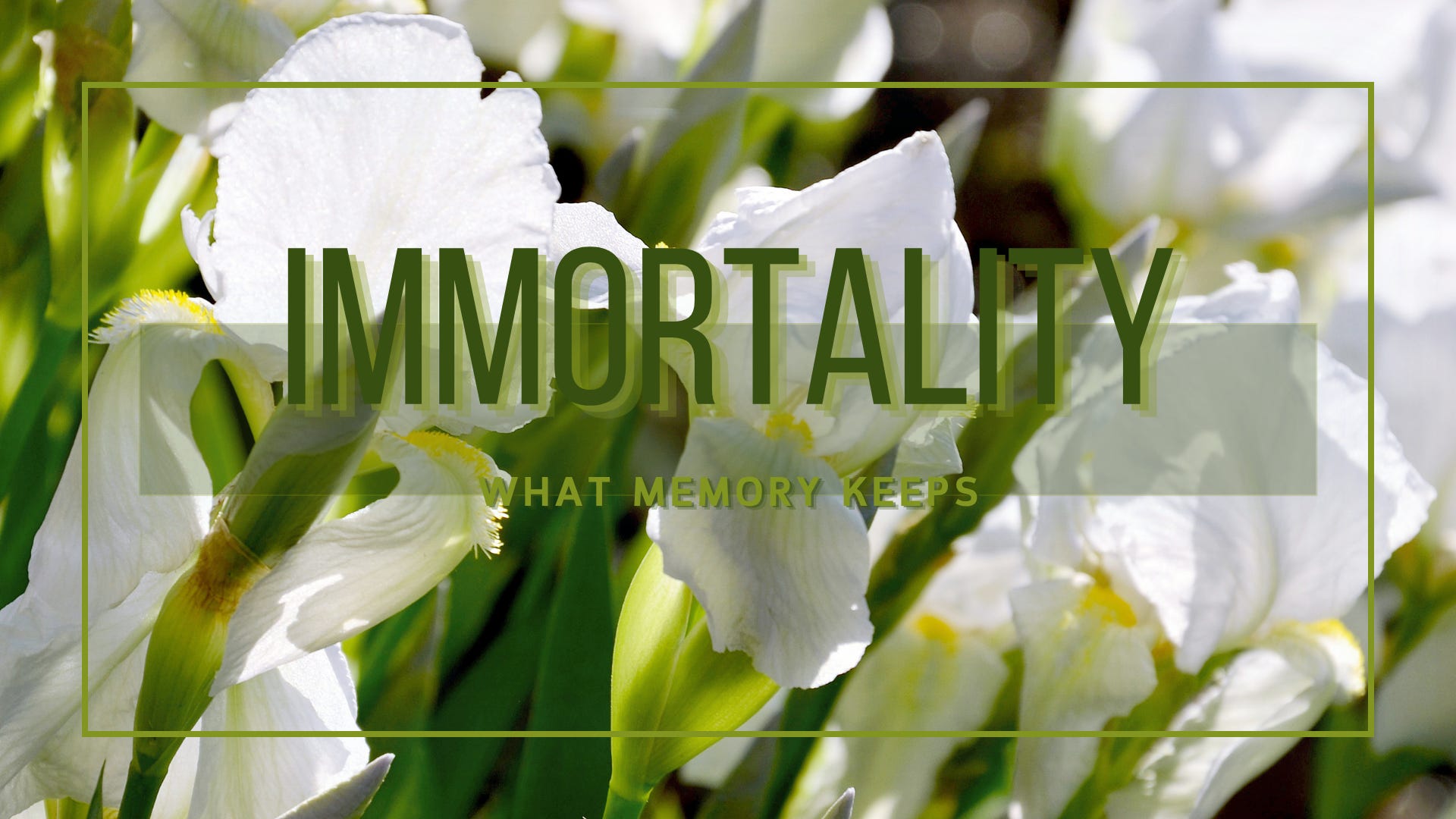
Not the way you remember a face already gone soft at its edges, a date, a year. She remembers the irises the way skin remembers cold water; it lives in the body, not the mind. The tall bearded ones along the fence, Immortality, the white variety, which was their name and the seed catalog’s earnest promise. And the deep purple ones her mother brought in a coffee can in October, planted in the dark because it was October and she was stubborn about timing and it was something that needed doing now.
That smell: powdery and green, and underneath both, something almost animal. Root-adjacent. You could stand inside it.
She stands inside it now.
Her daughter has been in the doorway for some minutes; she knows this without turning, knows the shape of that particular worry, and she does not turn. Not yet. The irises are open. Her hands know how to cup a bloom without breaking the stem, some precision lodged before language made its claims, and she brings her face down to the opened throat of one and breathes.
Nothing comes.
The nose reports nothing.
And still: the smell is there. This is not grief, or not only grief. It is something structural, bone in a body that has otherwise gone porous and wrong. She breathes again. Her daughter stays.
bell hooks wrote we cannot go back. But bell hooks did not have a brain that has decided to keep certain rooms locked and certain rooms open, in no particular order, for no legible reason. The memory of this smell survives here when other things (her daughter’s middle name, the year she graduated, whether she turned the stove off) do not. It is not fair. Nothing about this is fair, and also it is the only thing she has that belongs entirely to her.
The iris: Immortality. She doesn’t remember planting it.
The smell remembers her.

Author’s Note
This poem began with a question I couldn’t shake: what does memory keep when it keeps almost nothing? I was reading about retrospection and the mind’s selective time travel, and about what it means to make memory an instrument of presence rather than escape (including a poem by Diane Seuss that asks what memory can honestly be in hard times). Not a dwelling, she writes. Only instruction.
I kept returning to the irises. Immortality is an actual cultivar, white and tall, and the cruelty of that name against what dementia takes felt like the prose poem’s center of gravity. The woman in this poem can no longer smell her garden. But something held.
My sister lost her sense of smell and has dementia. I wanted to write about what holds.
Upcoming…
July’s writing prompt:
One Hundred-Word Wonders, 15 July 2026
This year, every prompt will come directly from movie titles.
For those who want a head start, this month’s prompt is: SAY ANYTHING. Write in exactly 100 words, a story, poem, or creative non-fiction in any genre, using the prompt. Pieces should be exactly 100 words, no more or less. The 100-word count does not include the title. Hold your piece until the 15th.

Thanks very much for reading, subscribing, and sharing the stories, poetry, and essays in this space. If you like a story, poem, or essay, please click on the heart. Also if you are so moved, please leave a comment.
