
Enchanted Aisle
Flash fiction about a small-town shopkeeper who discovers an ancient book, plus an update in the Author’s Note section.

THE RAIN HAD been going three days. Maplewood smelled like wet dog and disappointment, the particular damp that gets into walls and stays.
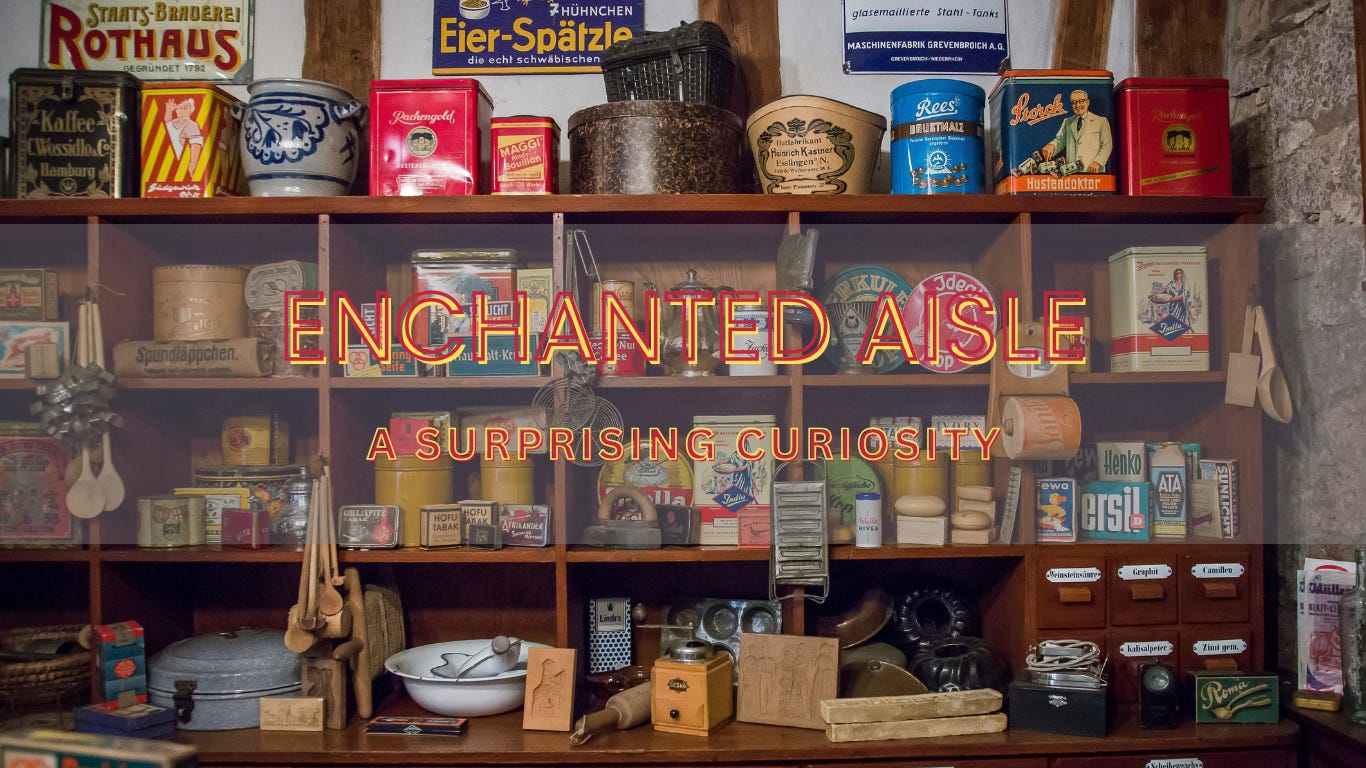
Harold Miller stood behind the counter at Curiosities & Crafts, waiting for customers who wouldn’t come. Twenty years, and he still collected that particular shame-heat when the bell above the door went unrung. He’d built the place himself—sourced the hand-painted mugs from a woman in Vermont, the carved walking sticks from a man in Asheville—and Maplewood mostly treated it as a curiosity in itself. Something between a pity and a joke.
He was rearranging old books when his hand knocked something behind the two ceramic gnomes. The gnomes had been there so long he’d stopped registering them. They tilted forward as he worked the thing free: a tome, black leather cracked like old skin, gold lettering on the cover gone brown at the edges. SECRETS OF THE ARCANE.
“Who on earth put this here?” He turned it over. Nothing on the back. He opened it.
The pages smelled like something underground. Diagrams crowded the margins—circles inside circles, creatures with too many limbs, symbols that kept almost resolving into letters. He found a long column of text in a language he couldn’t place, and without understanding why, he read aloud.
The words fit his mouth like they’d been waiting there.
The shop lurched. Not physically; nothing fell. But every object on the shelves seemed to sharpen, become more insistently itself. The mugs intensely mug-shaped. The light intensely light. Harold’s chest rang like a struck bell.
He set the book down. His hands shook. Not from fear, exactly. From animal recognition of something enormous.
The door opened. Liz Jenkins came in shedding rain from her coat, grey curls plastered to her forehead. She was the town librarian and she’d always been kind to Harold in the particular way people are kind to someone they feel slightly sorry for.
“Terrible out there,” she said. “Find anything good?”
He held up the tome. She crossed the room and squinted at the cover.
“Huh.” She took it from him and turned it over. “Where’d this come from?”
“Back of the shelf. Behind Gerald and Frank.” He gestured at the gnomes.
“You named them?”
“Gerald is the one with the chipped hat.”
She laughed. Harold’s chest did something complicated. He couldn’t remember the last time he’d made someone laugh without trying.

That night, above the shop, Harold sat at his kitchen table with the tome open and his coffee going cold. He’d read four more passages aloud. Each time, something below responded: a rustle, a creak, once the old radio cycling through frequencies until it found something. He’d gone down to check. The radio sat dark. Nothing out of place.
He dreamed badly.
In the dream, he stood in the shop while Maplewood streamed past the window—not walking, streaming, like a current—and every face was recognizable. Pete Weber, who called him “Harry” and once asked if the shop was a tax write-off. The Kowalski boys, who threw bottle caps at his window every October. The woman from the historical society who’d suggested he might consider “more conventional merchandise.” He opened the book. He read. Their faces changed.
He woke at four in the morning, drenched and breathing hard. The dream had felt so good.
Harold sat in the dark a long time with that knowledge.
Liz came back the next afternoon, which was unusual. She carried a paper bag from the bakery and wore an expression Harold associated with decisions already made.
“You tried something, didn’t you,” she said. Not a question.
“Read some passages.”
“And?”
He went to the shelf where a potted geranium had been dead since November. He found the marked page, read from it, low, like he was talking to himself.
The geranium straightened. Budded. By the third line it had a full red flower, open and slightly ridiculous in the January light.
Liz set down the paper bag.
“Harold.”
“I know.”
“Do you?”
He looked at the flower. “I had a dream. About using it to…” He stopped. “To make people here afraid of me.”
Liz was quiet. Rain hit the window.
“Were they afraid?” she asked.
“Yes.”
“And did it help?”
Harold pulled a dead stem from the pot’s soil, turned it over. “It helped while I was dreaming it.”
She nodded. She didn’t tell him to choose good over evil. She didn’t tell him power carried a price. She sat on the stool by the counter, opened the bakery bag, and pushed half a cinnamon roll toward him.
“I was terrible in high school,” she said. “Mean in the specific way girls get mean. There was a girl named Audrey. I still think about her.”
“Why are you telling me that?”
“Because wanting to scare people who made you feel small isn’t a character flaw. It’s arithmetic.” She looked at him. “What you do with it is the part that counts.”
Harold ate the cinnamon roll. Outside, a kid in a yellow slicker stopped at the window. The geranium was visible from out there. The kid pressed both palms against the glass.
He held a gathering the following Saturday. He didn’t advertise it exactly; mentioned it to a few people, let it spread the way small-town things do. By seven o’clock, a dozen neighbors crowded the shop.
He conjured small things. A candle that burned violet. Soap bubbles that held their shape forty-five seconds before going. He read a passage over Pete Weber’s dying succulent and watched it regreen in real time. Pete said “you’re joking” four times in a row without apparently noticing.
The children were the easiest audience. One girl, maybe six, held out her palm and Harold placed a glowing orb in it, warm, about the size of a plum. She looked at him like he was made of different material than ordinary men. That look landed somewhere in his chest and stayed.
By the end of the night, he understood something that surprised him in its plainness: this wasn’t about revenge. Not because revenge was wrong, maybe it wasn’t, always. But because this was better. This was a room full of people making sounds he’d never drawn from them before. This was belonging arrived at sidewise, through a dead geranium and a misfiled tome and twenty years of standing behind a counter feeling transparent.
He did not feel transparent now.
After everyone left, Liz helped him stack chairs. Neither of them talked for a while.
“Gerald and Frank,” she finally said. “You know they’re the reason you found it. If you’d ever dusted back there…”
“Never occurred to me.”
“Obviously.” She pulled on her coat. “Same time next week?”
Harold looked around the shop. The violet candle had gone out but left a smell like warm stone in the air. The geranium stood in the window, still red.
“Yeah,” he said. “Same time next week.”
Author’s Note
When I started writing this fantasy a year ago, I envisioned weaving a tale steeped in horror or speculative fiction.
Fast-forward to today, and I have a confession: I’m struggling to dive into the darker corners of my imagination. While my poetry flows freely, often feeling like it originates from a realm beyond my reach, conjuring scenes of horror and darkness feels like an arduous task.
Perhaps it’s the weight of my emotions that has me yearning for lighter themes. I’ve been wrestling with something I can’t quite name—could it be anticipatory grief? Some days, the harsh realities of the world are suffocating.
In part, I mean the current turmoil by the U.S. regime. Still, on a more personal level, I’m navigating the heartbreaking decline of my mother-in-law, a vibrant woman whose spirit is dimming under the shadow of illness.
As we watch her transform from a lively presence into a fragile figure ravaged by cancer’s cruel grasp—whittled down to painful grimaces, succumbing to the indignities that come with being bedridden—it feels like a slow-motion loss.
My husband and I mourn her transformation and the remarkable person she once was. We opted for in-home hospice care. With that, we hope to relieve her pain and ensure she is as comfortable as possible in familiar surroundings.
Yet amidst this heaviness, nature offers me a sanctuary. As I wander along the edges of the woods, I find solace in the rhythmic dance of fern fronds, the intriguing shapes of various mushrooms, and the delicate blooms of tiny plants, like the five-spot and ghost plant, that are just revealing themselves. I also tread carefully to avoid disturbing the little frogs and toads. In this setting, I feel a connection that momentarily eases my burden.
Why did I tell you this? I wanted to take a moment to share something personal with you. I’ve been a bit quiet lately when it comes to engaging with Substack subscriptions and comments, and I sincerely apologize for that. I truly appreciate your patience as I navigate through this challenging time. Your understanding means the world to me, and I’m looking forward to catching up with all of you soon!
Upcoming…
May’s writing prompt:
One Hundred-Word Wonders, 21 May 2025
For those who want a head start, this month’s prompt is SEIZE THE MOMENT. Write in exactly 100 words, a story, poem, or creative non-fiction in any genre, using the prompt. Pieces should be exactly 100 words, no more or less. The 100-word count does not include the title. Hold your piece until the 21st!

Thanks very much for reading, subscribing, and sharing the stories, poetry, and essays in this space. If you like a story, poem, or essay, please click on the heart. Also if you are so moved, please leave a comment.

So sorry to hear about your mother in law. Yeah in this circumstances I can appreciate you don't want to dwell in the dark but be in the light and embrace nature.
I’m so sorry to hear about your mother in law, Caro. I remember you telling me she was in poor health, but it’s such a shame that she is deteriorating. It must be very tough for yourself and your husband. I’m thinking of you both
Enchanted Aisle was a lovely story 👍🏼