

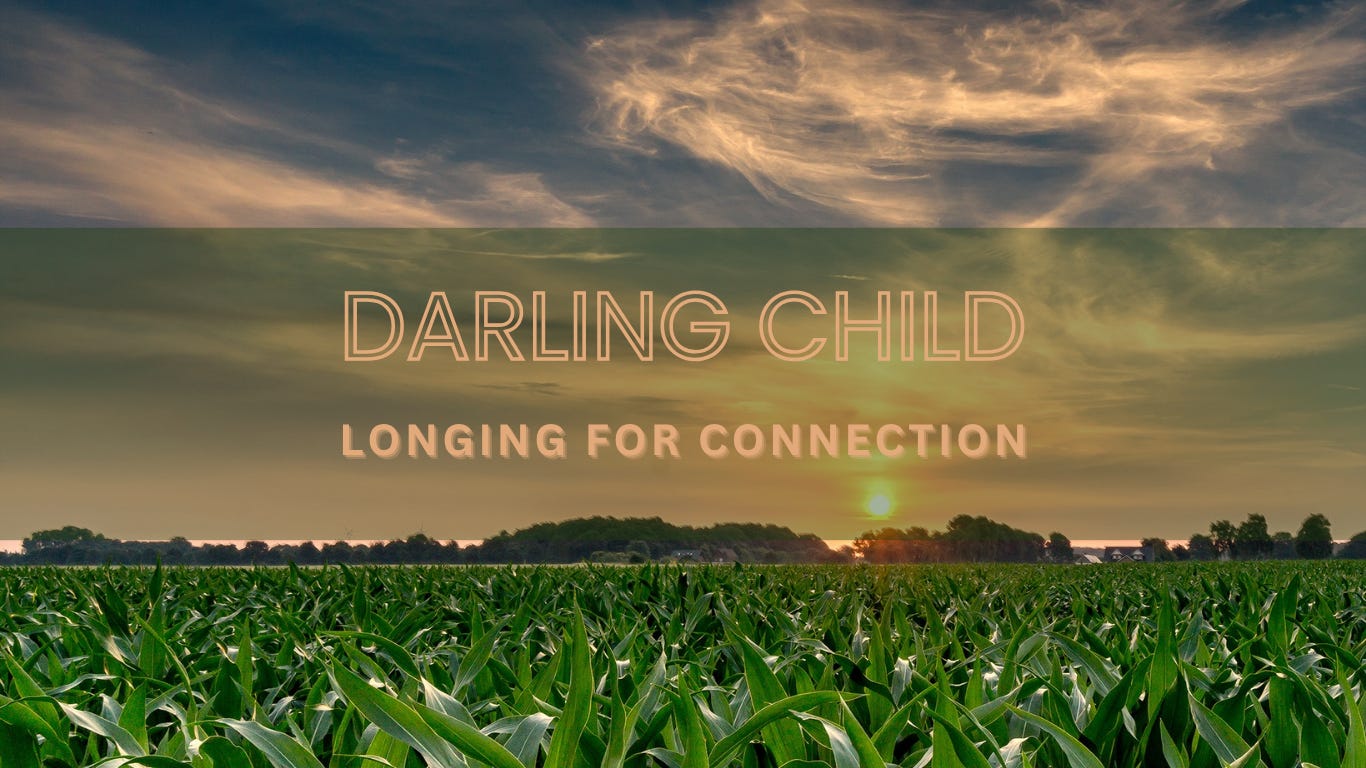
THE CORN STOOD taller than Amy remembered, though nothing about her had grown to meet it. Ten years old in 1962 and ten years old now, however many winters had since iced over the pond behind the Hollis place. She counted seasons sometimes, the way other children counted coins, except her hoard never spent and never multiplied. It just sat there, cold and exact.
She’d come back to the field because the field was the last place her mother’s voice had sounded like itself.
Stalks raked her arms as she cut through the rows, leaving thin lines that welled red, then sealed shut before she’d gone ten more steps. That part she’d gotten used to. What she hadn’t gotten used to was the quiet that swallowed every name she called. Mom. The word went out flat into the dusk and came back to her unanswered, again, the way it had every night for longer than she let herself add up.
A girl had done this to her, here, the summer they’d flattened their backs into the dirt and swept their arms wide to leave corn angels, wings dragged through the stalks. The girl had no name Amy could hold onto anymore, just teeth and a laugh gone wrong halfway through, and after, a hunger that moved into Amy’s chest like a tenant who never paid rent and never left.
She broke from the corn into the tree line. The woods past the Hollis field had always felt rehearsed to her, every root in its place, every branch arranged like a stage set for whatever happened next. Tonight a fire had been lit somewhere off to the left, smoke threading up gray between black branches, and beneath that smell sat another one, older, warmer. Amy’s mouth filled before her mind caught up to why.
The clearing opened around an oak so wide three grown men couldn’t ring it with their arms. A woman stood with her back against the bark, hair loose around her shoulders, a cardigan buttoned wrong by one hole. Amy’s knees went liquid.
“Mom.”
The woman turned. Whatever name she’d been about to call out for died somewhere behind her teeth. Her hand rose to her collarbone the way hands do when a body needs proof it’s still attached to itself.
“Amy?” Sarah’s voice cracked down the middle of the word. “Baby, is that…how are you even…”
She crossed the clearing in four steps and folded her daughter into her arms, and Amy let herself be folded, let her face press into wool that smelled like the inside of a cedar chest and like home and like every Tuesday she used to fall asleep against this same shoulder during car rides nobody remembered the destination of.
Underneath the cardigan, a pulse beat against Amy’s cheek. Steady. Close.
The hunger that had been a tenant became a tenant with a key.
“I missed you,” Amy said into the wool, and meant it more than she’d meant anything in ten years stacked end to end like empty rooms.
“I never stopped looking,” Sarah said. “I told them you’d wandered off. I told them a hundred things. None of them were ever this.”
Amy’s fingers curled into the back of the cardigan. Her jaw ached in a way that had nothing to do with crying.
“Sweetheart.” Sarah pulled back an inch, just enough to study her daughter’s face in the failing light, and something in her own face folded inward, confusion sliding toward a fear she hadn’t named yet. “You’re cold. You’re so cold.”
“I can’t be by myself anymore.” The words came out of Amy thin and stripped, the way truth sounds when there’s no performance left in it. “I tried. I tried for so long.”
“You don’t have to be alone. Come home. We’ll fix whatever’s…we’ll figure it out together, we always…”
Amy struck before the sentence finished, before her own mind had voted on it, the way a hand snaps back from a stove a full second before the brain registers heat. Her mouth found the curve of her mother’s throat and the taste that flooded in was warmth itself, was every lullaby ever hummed off-key, was a decade of cold rooms going suddenly, finally, unbearably bright.
Sarah’s hands gripped Amy’s shoulders. Not pushing away. Holding on, the way you hold on to a railing when the floor tilts.
“Amy.” Barely air now, barely sound. “Amy, no…”
The pulse against Amy’s lips slowed, then stuttered, then went the way a clock goes when no one winds it. Amy didn’t let go until there was nothing left worth holding onto, and even then her arms stayed locked around the body that had gone soft and unfamiliar in a way no decade of imagining could have prepared her for.
She lowered her mother to the moss at the base of the oak. Tucked the cardigan straight. Smoothed one strand of hair from Sarah’s forehead, the gesture backward now, the daughter performing what the mother used to do for her on fever nights.
The fire she’d smelled earlier had burned down to nothing. No more smoke threading the dark.
Amy knelt there until her knees went numb against the cold ground, running the math she’d refused to run for ten years: that the loneliness had never been the corn, or the woods, or the years stacked up like unread mail. The loneliness had been her. It would keep being her, in every clearing, with every person she let herself love enough to need.
She rose. Wiped her mouth with the back of one sleeve, an old habit from when sleeves were for milk and not this. Somewhere beyond the tree line, real dawn or what passed for it would be working its way up over the Hollis farm, and somewhere past that, other people existed who had learned to carry this exact hunger without setting down everything they touched.
She would have to find them. There wasn’t a version of this left where she didn’t.
Amy looked once more at the shape under the oak, the shape that used to answer when she called, and walked out of the clearing the way a person walks out of a room where something has just finished happening. Not fast. Not slow. Just forward, because forward was the only direction that hadn’t already burned.

Author's Note
So, I have a lot to unpack here, but I’ll only touch on a few things.
I wrote a few posts ago about being unable to write horror. That still stands, as I don’t firmly put this story in that genre.
Two weeks ago, this story popped into my mind without a reference point (or so I thought). It clamored in my head, demanding I write the words.
I now believe the recent passing of my mother-in-law and my mother’s loss eleven years ago inspired me to tell this story of a young vampiress searching for her mother. At night, when the settling house was the only sound, memories of them brought sadness, yes, but also comfort, revealing the layers of love and loss I felt. Writing this story became my way of connecting with the mothers I wish were still in my life.
Grief isn't linear; it ebbs and flows, intertwining sorrow, anger, and guilt. Initially, their absence consumed me, but I eventually recognized that my grief reflects the love we shared. I confronted the void through rituals—planting flowers they loved, surrounding myself with memories, and conversing with them in my thoughts. Writing became my release and tribute, allowing their essence to thrive.
As I created the young vampiress’s journey, I saw my longing mirrored in her search—an exploration of love that persists beyond death. This story embraces the grieving process as a step toward healing, reminding me that grief signifies strength and deep love.
In seeking my mothers, I recognize their memory shapes my life and art. The young vampiress’s quest illustrates that every step taken in pursuit of understanding is evidence of enduring love, lighting the way through the darkest nights.
Upcoming…
A poem about self-love and acceptance:
Otherness, 14 June 2025

Thanks very much for reading, subscribing, and sharing the stories, poetry, and essays in this space. If you like a story, poem, or essay, please click on the heart. Also if you are so moved, please leave a comment.

This is an outstanding story, and reading the story behind it, magnified the impact. I was moved by your grief, and the conflict in your story.
A wonderful story, Caro. I’m so sorry for your loss 🙏